I was in Alice Springs a couple of weeks or so and witnessed episodes of what they're coyly referring to as 'anti-social behaviour'.
It was generally harmless - the odd drunk humbugging for money.
But I did watch a couple of kids (black and white;14 y.o?) wind themselves up to have a fight with a German tourist.
Lots of loud and bad language.
Windmilling arms.
Ostentatious taking off of shirts.
Preparing for a fight.
It looked ugly, but didn't go much further than that.
A few days before there'd been a 'riot'.
Self-appointed vigiliantes took to the streets, but overweight men with red faces don't scare pumped-up kids who can run a lot faster.
Not much.
A few days later there were a couple of fatal stabbings.
And then the Chief Minister was in town for a regional sittingCabinet meeting of our town council sized and grandiosely -named 'Parliament'.
She copped a fair amount of abuse from people who were 'scared to go out', 'sick and tired of violence' and 'waiting for something to be done'.
The something?
More police.
Less tolerance.
Laura Norder.
But they're not yet prepared to see Alice Springs become a dry town (no public drinking whatsoever).
That's bad for business.
It's about what you'd expect, really.
No-one's prepared to look at the whys and wherefores, though.
Like, why is it happening?
I got a clue sitting in restaurant one night.
There was party of white people across the room.
Lots of wine and loud voices.
One stood out: 'The thing you have to realise about Alice Springs is that nobody comes from here; we're all from somewhere else'.
It's bullshit, of course.
It's not even true of white people: several families have been around the Centre for a few generations now; and I have friends of middle age who were born there and whose parents were born there.
But it says a lot about how some - many - whites view blacks.
They're interlopers who don't belong in a whitefella tourist-fuelled economic wet dream that only exists in this arid, but long-peopled landscape, because their culture lives and tourists want to experience it before it too dies.
Forget about the Mparntwe people, the custodians of Yeperenye, the Caterpillar Dreaming.
Forget about the fact that you're as likely to hear Arrernte on the radio as you are English.
To the nouveau Alice Springs resident, they're invisible.
Marginalised.
And what is the last desperate resort of marginalised people?
All together now....
Monday, April 23, 2007


Monday, April 16, 2007
Travelling North: On the Road

The term 'desert' doesn't do justice to the amazing variety of micro-environments that pattern the arid inland of Australia.
Think about the complexity in so-called 'dot' painting, then look at Google Earth's view of the Centre from the sky.
I travelled both south and north in a round trip of more than 8000km last month.
We drove to Melbourne for my eldest son's wedding and then I drove back solo, accompanied only by Warren Zevon, The Chieftains, Lyle Lovett, JS Bach, WA Mozart, Jimmy Dale Gilmore, Alison Krauss and Guy Clark.
This is one of the amazing views from the road - the top end of a large complex of salt lakes in the country to the south-west of Woomera.
Day 1 I drove from just out of Melbourne to Burra, in mid-north south Aust, via Mildura, Renmark and Morgan.
Day 2 was Burra to Coober Pedy via Horrocks Gap into Port Augusta.
Day 3 Coober Pedy to Alice Springs.
Day 4 Alice Springs to the Highway Inn.
And Day 5 Highway Inn to Darwin.
See more pics on our web album.
Vale Kurt Vonnegut
Dry insights, mordant wit and spare prose: his writing shone in my youth, although I felt that in his later years, which were marked by depression, he tended to lapse into self-parody.
Now old Kurt has been swallowed up by the great chronosynclastic infundibulum in the sky.
So it goes.
Poot-tee-wheet
Now old Kurt has been swallowed up by the great chronosynclastic infundibulum in the sky.
So it goes.
Poot-tee-wheet
Tuesday, April 10, 2007
It might be neat and tidy, but is it democratic?
Back in the bad old days of serious machine politics in the various state Labor parties, the numbers men exhorted the faithful to 'vote early and vote often'.
In some wards, the dead rose from their graves to vote repeatedly at different polling booths.
That was then.
We've since got an independent statutory body - the Australian Electoral Commission - which oversees elections at every level.
Our elections - apart from the extremely rare occurrence of missing ballot boxes in some organisational elections - are usually straight.
We have a formal electoral roll and what used to be a pretty straightforward enrolment process with a reasonable period for enrolment after elections are called.
But that's changing as of 16 April this year.
For the rest of this week, you can enrol by giving name, address, citizenship status and birthdate and getting someone who is already on the roll to witness your signature.
Next week, you'll have to provide full ID and choose from a small menu of authorised people to both view your ID and witness your enrolment application.
If you're in prison, you now lose the right to vote.
Forget about internationally-recognised civil and political rights.
Cons will not be able to exercise them
And if they called an election tomorrow, you'd have until 8pm the same day to register if you'd forgotten to do it beforehand.
In a literate society, this should not be a problem.
But what about in remote areas, where many Aboriginal people - particularly the young - are barely literate?
Many simply do not carry their own documentation, leaving banks, stores and health clinics to look after ATM cards, Medicare cards and the like.
In order to enrol, they'd have to round up their ID, then find one of the authorised people and then fill out the form - or get someone to do it for them.
If they live on an outstation, they might not hear about an election being called.
So if they haven't enrolled, the chances of rounding up the ID, getting an authorised person to witness the form and then faxing it off to the Electoral Commission in time are pretty slim.
There's a big enrolment drive on in the territory at the moment, to try and make sure that Aboriginal people aren't disenfranchised by the move.
Funnily enough, not that many of them are likely to vote for the current government, whose Indigenous policies derive their intellectual foundations from the philosophy of assimilation.
They're also pretty good at blaming the victim, too.
The Chairman of the Joint Parliamentary Standing Committee on Electoral Matters - a member of the governing party - said, without going into specifics, that the changes would stop the 'deluge of last-minute enrolments', which increased the scope for fraud and manipulation of electoral roll.
But as one of the activists who run the GetUp website pointed out, new technology should make voting easier and if the the government wanted the roll to be accurate and up to date, they should be allowing people to enrol.
Not making it harder and harder for them.
But no, they pushed the legislation through Parliament last year and it's sat there waiting for deadline - pretty well unnoticed by all but a few.
I took part in a survey by my union - the Media Alliance - and was asked if I was aware of the coming changes to the Electoral Act.
I think I surprised the interviewer with the extent of my knowledge.
She told me after the interview that only one in 30 members - yes folks, about three per cent - of the membership were aware of what was happening.
So if the media doesn't know, how are the punters going to find out?
Unnoticed changes might make the process neater.
But are they democratic?
In some wards, the dead rose from their graves to vote repeatedly at different polling booths.
That was then.
We've since got an independent statutory body - the Australian Electoral Commission - which oversees elections at every level.
Our elections - apart from the extremely rare occurrence of missing ballot boxes in some organisational elections - are usually straight.
We have a formal electoral roll and what used to be a pretty straightforward enrolment process with a reasonable period for enrolment after elections are called.
But that's changing as of 16 April this year.
For the rest of this week, you can enrol by giving name, address, citizenship status and birthdate and getting someone who is already on the roll to witness your signature.
Next week, you'll have to provide full ID and choose from a small menu of authorised people to both view your ID and witness your enrolment application.
If you're in prison, you now lose the right to vote.
Forget about internationally-recognised civil and political rights.
Cons will not be able to exercise them
And if they called an election tomorrow, you'd have until 8pm the same day to register if you'd forgotten to do it beforehand.
In a literate society, this should not be a problem.
But what about in remote areas, where many Aboriginal people - particularly the young - are barely literate?
Many simply do not carry their own documentation, leaving banks, stores and health clinics to look after ATM cards, Medicare cards and the like.
In order to enrol, they'd have to round up their ID, then find one of the authorised people and then fill out the form - or get someone to do it for them.
If they live on an outstation, they might not hear about an election being called.
So if they haven't enrolled, the chances of rounding up the ID, getting an authorised person to witness the form and then faxing it off to the Electoral Commission in time are pretty slim.
There's a big enrolment drive on in the territory at the moment, to try and make sure that Aboriginal people aren't disenfranchised by the move.
Funnily enough, not that many of them are likely to vote for the current government, whose Indigenous policies derive their intellectual foundations from the philosophy of assimilation.
They're also pretty good at blaming the victim, too.
The Chairman of the Joint Parliamentary Standing Committee on Electoral Matters - a member of the governing party - said, without going into specifics, that the changes would stop the 'deluge of last-minute enrolments', which increased the scope for fraud and manipulation of electoral roll.
But as one of the activists who run the GetUp website pointed out, new technology should make voting easier and if the the government wanted the roll to be accurate and up to date, they should be allowing people to enrol.
Not making it harder and harder for them.
But no, they pushed the legislation through Parliament last year and it's sat there waiting for deadline - pretty well unnoticed by all but a few.
I took part in a survey by my union - the Media Alliance - and was asked if I was aware of the coming changes to the Electoral Act.
I think I surprised the interviewer with the extent of my knowledge.
She told me after the interview that only one in 30 members - yes folks, about three per cent - of the membership were aware of what was happening.
So if the media doesn't know, how are the punters going to find out?
Unnoticed changes might make the process neater.
But are they democratic?
Monday, April 09, 2007
No, Minister
It's months since I've posted.
Christmas intervened and then it got harder and harder to sit down and write something.
But I'm back!
The state of education has hit the news recently; more specifically the low levels of literacy and numeracy recorded in the Northern Territory as compared with other States and Territories.
We know we don't perform as well because the national benchmarking Multilevel Assessment Program tests (the MAP tests) say so.
What the MAP tests actually show is that the performance in urban and regional schools compares favourably with Down South.
It's the remote schools in Aboriginal communities, however, that show very poor returns: in some cases only around 30 per cent of kids actually perform at benchmark level.
And that's a terrific opportunity for talkback radio to get into the whys and wherefores.
So they wheel out the Minister for Education for an explanation.
A practised politician, he has no difficulty - nor hesitation - in fluently repeating the advice his Department has given him.
Kids in remote Aboriginal schools don't perform as well because they don't attend school.
All we have to do is attend regularly and everything will be hunky-dory.
Right.
The reality is a bit more complex than that.
What we're talking about - remote schooling - is still essentially a colonialist enterprise.
It's a valiant attempt to impart Western values and styles of knowledge that blithely ignores the complexities of working across languages and cultures.
In this context, it's not simply enough to provide schools and teachers and expect kids will automatically turn up.
You have to give them a reason for being there.
You have to bend your pedagogy and then your curriculum to accommodate cross-cultural, multilingual contexts, such as schools where kids may speak up to five languages and may speak Aboriginal English or Kriol as a sixth, but they don't speak, read or write a more formal English.
You have to make sure your teachers are fully trained, sensitive and mature enough to meet the demands; not simply recruit warm bodies to front a classroom and emerge at the end of the day more or less sane.
You have to work out the conditions that are necessary to keep teachers out bush, so that you've got continuity in people and programs.
And you have to have consistent and sustained support from your department.
Blaming kids can't hide the fact that the department is doing none of the above.
But it's what many people in the Territory want to hear.
It's yet more 'proof' that blackfellas are to lazy to get off their arses and make sure their kids go to school so they can get the benefits that we're supposedly offering.
That the assertion doesn't stand up to intelligent scrutiny doesn't stop the department running the line.
Fortunately, I was interviewed as a representative of the school councils' combined organisation and I got a good response to my suggestion that we needed to look at our own performance - as I've listed above - before we start blaming kids for their failure to perform at level.
I was followed by a senior bureaucrat who stuck to the line, which by then had become slightly modified to: 'well kids who do attend school have no problems with their literacy'.
No, Minister, this simply ain't good enough.
Aboriginal kids are the fastest-growing cohort in our schools and unless we tailor the system to meet their complex needs, they're missing out.
Dealing with this is not just a matter of equity.
It ought to be, to use a classic piece of modern bureaucratic cant, 'core business'.
Christmas intervened and then it got harder and harder to sit down and write something.
But I'm back!
The state of education has hit the news recently; more specifically the low levels of literacy and numeracy recorded in the Northern Territory as compared with other States and Territories.
We know we don't perform as well because the national benchmarking Multilevel Assessment Program tests (the MAP tests) say so.
What the MAP tests actually show is that the performance in urban and regional schools compares favourably with Down South.
It's the remote schools in Aboriginal communities, however, that show very poor returns: in some cases only around 30 per cent of kids actually perform at benchmark level.
And that's a terrific opportunity for talkback radio to get into the whys and wherefores.
So they wheel out the Minister for Education for an explanation.
A practised politician, he has no difficulty - nor hesitation - in fluently repeating the advice his Department has given him.
Kids in remote Aboriginal schools don't perform as well because they don't attend school.
All we have to do is attend regularly and everything will be hunky-dory.
Right.
The reality is a bit more complex than that.
What we're talking about - remote schooling - is still essentially a colonialist enterprise.
It's a valiant attempt to impart Western values and styles of knowledge that blithely ignores the complexities of working across languages and cultures.
In this context, it's not simply enough to provide schools and teachers and expect kids will automatically turn up.
You have to give them a reason for being there.
You have to bend your pedagogy and then your curriculum to accommodate cross-cultural, multilingual contexts, such as schools where kids may speak up to five languages and may speak Aboriginal English or Kriol as a sixth, but they don't speak, read or write a more formal English.
You have to make sure your teachers are fully trained, sensitive and mature enough to meet the demands; not simply recruit warm bodies to front a classroom and emerge at the end of the day more or less sane.
You have to work out the conditions that are necessary to keep teachers out bush, so that you've got continuity in people and programs.
And you have to have consistent and sustained support from your department.
Blaming kids can't hide the fact that the department is doing none of the above.
But it's what many people in the Territory want to hear.
It's yet more 'proof' that blackfellas are to lazy to get off their arses and make sure their kids go to school so they can get the benefits that we're supposedly offering.
That the assertion doesn't stand up to intelligent scrutiny doesn't stop the department running the line.
Fortunately, I was interviewed as a representative of the school councils' combined organisation and I got a good response to my suggestion that we needed to look at our own performance - as I've listed above - before we start blaming kids for their failure to perform at level.
I was followed by a senior bureaucrat who stuck to the line, which by then had become slightly modified to: 'well kids who do attend school have no problems with their literacy'.
No, Minister, this simply ain't good enough.
Aboriginal kids are the fastest-growing cohort in our schools and unless we tailor the system to meet their complex needs, they're missing out.
Dealing with this is not just a matter of equity.
It ought to be, to use a classic piece of modern bureaucratic cant, 'core business'.
Sunday, October 29, 2006
First there is a river, then there is no river...
My apologies to Donovan, folks.
This is a story about a river and the place of that river in an Aboriginal culture, but it's also a story about mining.
But first a wee bit of history. More than forty years ago, a Swiss mining company - one of the then giants of the world bauxite trade - bulldozed its way into the consciousness of Yolngu people of North East Arnhem Land when surveyors found substantial deposits of the mineral under clan estates.
The Yolngu leaders tried everything to stop the mine, including legal action and an appeal to Parliament that revealed the legal title deeds to those estates in the form of a composite bark painting that showed the clan stories.
All to no avail. The Australian Government of the day issued the licence and they got a mine. They got a town. And they got a pub.
In the process, they saw the authority of their leaders disregarded, their lands alienated and their sacred sites desecrated. One celebrated photograph shows a senior man sitting by helplessly as a big D9 Cat rips into a sacred tree near his camp. It's arguable whether the Yolngu have ever recovered from the psychic shock of the rape.
Throughout their ownership of the mine, which ended a few years ago, Alusuisse continued to treat local landowners with the same disdain.
Small wonder when, as I discovered only within the past five years or so, Alusuisse assumed its leading position in the industry on the backs of slave labour - Jews, gypsies, homosexuals, displaced people from throughout Europe - supplied to their mates by the Nazis from their concentration camps. Nice people, eh?
And now another Swiss-owned mining company - Xstrata - is about to do another act that will desecrate a sacred place, with the inevitable cultural fall-out.
Xstrata has been mining various minerals at a mine on the Macarthur River, a few hundred kilometres from Darwin and in the floodplain country that stretches north to the Gulf of Carpenteria.
It wants to extend the mine and open up a huge open cut operation. That in itself is environmentally dodgy. One Wet a couple of years ago, the mine site had nearly TWO METRES of rain in a week. But the really dodgy thing about this operation is that they want to divert the river for about five kilometres.
Yes. Divert a river.
Shades of the 1950s? The can-do philosophy that made America what it is? (Q: What is America? Rasta answer - Babylon; Muslim answer - The Great Shaitan. Ask people in Chile and Nicaragua. Or Vietnam. Or Panama. Or Palestine. Take your pick.)
Whichever it is, it's an act of wilful cultural vandalism rather than an engineering miracle. The Macarthur River is the Rainbow Serpent and where they want to divert it is a particularly sacred part of the story.
So did the Swiss back off?
Not on your life. Sensing that they were operating on questionable ground, they threatened the Northern Territory government that they'd withdraw the entire operation - which they claimed meant the NT losing millions of dollars and hundreds of jobs - if the government refused to let them divert the river.
Their argument has been revealed as somewhat piss-weak: most of the jobs on site are filled by fly-in fly-out workers from other States; and they haven't paid any money over to the NT anyway.
Nonetheless, the NT government caved in and the Mines Minister announced the other day that the mine and the river diversion would go ahead. As far as we know, there's yet to be an acceptable package of compensation for the Aboriginal people of the region. Y
anyuwa traditional owners from the region came to Darwin to protect, but the dirty deed was done. They looked the parliament in the eye, though, and not a few on the padded benches flinched.
One who didn't was herself a Yanyuwa woman - Barbara McCarthy, a former journalist who won the local seat of Arnhem at our last elections for the ruling Labor Party. Barbara was painted up by her elders with ochre and she wore the paint proudly as she stood up and questioned the deal.
Predictably, her motives were questioned, since she accepted party discipline until the deed was done and spoke up only after the event. I think she did a brave and honest thing, the right thing by her people.
The company, equally predictably, tried to play down what she'd been saying. They continue to insist that they've got the traditional owners on side and they have a really good package to hand to them.
Previous experience with overseas mining companies in the bad old days suggests that this is so much old cobblers. They might well have talked to the very few people who were likely to agree with them. They might have offered inducements to those few. But they sure as hell don't have the agreement of the real custodians of that country and its stories.
And it all makes me wonder what's happened to a Labor Party that behaves much like the Tories we revile.
In the bad old days of conservative rule in the Territory, you could count on blackfellas getting the rough end of the pineapple every time. I didn't expect to see it done so blatantly - and so consistently - under a Labor government.
Perhaps that's why people don't trust politicians any more. Social democracy is not worth shit if the underdogs keep losing.
This is a story about a river and the place of that river in an Aboriginal culture, but it's also a story about mining.
But first a wee bit of history. More than forty years ago, a Swiss mining company - one of the then giants of the world bauxite trade - bulldozed its way into the consciousness of Yolngu people of North East Arnhem Land when surveyors found substantial deposits of the mineral under clan estates.
The Yolngu leaders tried everything to stop the mine, including legal action and an appeal to Parliament that revealed the legal title deeds to those estates in the form of a composite bark painting that showed the clan stories.
All to no avail. The Australian Government of the day issued the licence and they got a mine. They got a town. And they got a pub.
In the process, they saw the authority of their leaders disregarded, their lands alienated and their sacred sites desecrated. One celebrated photograph shows a senior man sitting by helplessly as a big D9 Cat rips into a sacred tree near his camp. It's arguable whether the Yolngu have ever recovered from the psychic shock of the rape.
Throughout their ownership of the mine, which ended a few years ago, Alusuisse continued to treat local landowners with the same disdain.
Small wonder when, as I discovered only within the past five years or so, Alusuisse assumed its leading position in the industry on the backs of slave labour - Jews, gypsies, homosexuals, displaced people from throughout Europe - supplied to their mates by the Nazis from their concentration camps. Nice people, eh?
And now another Swiss-owned mining company - Xstrata - is about to do another act that will desecrate a sacred place, with the inevitable cultural fall-out.
Xstrata has been mining various minerals at a mine on the Macarthur River, a few hundred kilometres from Darwin and in the floodplain country that stretches north to the Gulf of Carpenteria.
It wants to extend the mine and open up a huge open cut operation. That in itself is environmentally dodgy. One Wet a couple of years ago, the mine site had nearly TWO METRES of rain in a week. But the really dodgy thing about this operation is that they want to divert the river for about five kilometres.
Yes. Divert a river.
Shades of the 1950s? The can-do philosophy that made America what it is? (Q: What is America? Rasta answer - Babylon; Muslim answer - The Great Shaitan. Ask people in Chile and Nicaragua. Or Vietnam. Or Panama. Or Palestine. Take your pick.)
Whichever it is, it's an act of wilful cultural vandalism rather than an engineering miracle. The Macarthur River is the Rainbow Serpent and where they want to divert it is a particularly sacred part of the story.
So did the Swiss back off?
Not on your life. Sensing that they were operating on questionable ground, they threatened the Northern Territory government that they'd withdraw the entire operation - which they claimed meant the NT losing millions of dollars and hundreds of jobs - if the government refused to let them divert the river.
Their argument has been revealed as somewhat piss-weak: most of the jobs on site are filled by fly-in fly-out workers from other States; and they haven't paid any money over to the NT anyway.
Nonetheless, the NT government caved in and the Mines Minister announced the other day that the mine and the river diversion would go ahead. As far as we know, there's yet to be an acceptable package of compensation for the Aboriginal people of the region. Y
anyuwa traditional owners from the region came to Darwin to protect, but the dirty deed was done. They looked the parliament in the eye, though, and not a few on the padded benches flinched.
One who didn't was herself a Yanyuwa woman - Barbara McCarthy, a former journalist who won the local seat of Arnhem at our last elections for the ruling Labor Party. Barbara was painted up by her elders with ochre and she wore the paint proudly as she stood up and questioned the deal.
Predictably, her motives were questioned, since she accepted party discipline until the deed was done and spoke up only after the event. I think she did a brave and honest thing, the right thing by her people.
The company, equally predictably, tried to play down what she'd been saying. They continue to insist that they've got the traditional owners on side and they have a really good package to hand to them.
Previous experience with overseas mining companies in the bad old days suggests that this is so much old cobblers. They might well have talked to the very few people who were likely to agree with them. They might have offered inducements to those few. But they sure as hell don't have the agreement of the real custodians of that country and its stories.
And it all makes me wonder what's happened to a Labor Party that behaves much like the Tories we revile.
In the bad old days of conservative rule in the Territory, you could count on blackfellas getting the rough end of the pineapple every time. I didn't expect to see it done so blatantly - and so consistently - under a Labor government.
Perhaps that's why people don't trust politicians any more. Social democracy is not worth shit if the underdogs keep losing.
Saturday, October 14, 2006
It's a conspiracy!
How's this for a conspiracy theory:
'Bureaucrats imported from draconian southern states are trying to destroy the Northern Territory's unique lifestyle and heritage. They come to Darwin for a few miserable years with no intention of staying or making innovative and intelligent decisions. Their aim is to implement the laws that have already been imposed on states that have no relationship or understanding of our truly unique part of Australia.'
So what's the burning issue? What's the infringement of our civil liberties? What's threatening to destroy our 'unique lifestyle and heritage'?
Never in your wildest dreams would you guess that it's simply a proposal to impose a speed limit on the Stuart Highway, all 1900 kms of road that stretches from Darwin to the South Australian border.
The reason?
We have a road toll that's out of all proportion to our population of 200,000-odd; 34 people (that's 17 in every 100,000) have died on our roads since Jan 1 and countless people have been injured.
Speed and booze are major contributors, but the state of the roads and the skill of drivers play a part too.
The highway has no speed limit outside built-up areas.
Theoretically, you can drive at any speed you like.
The police have a caveat - 'safest' speed - which enables them to prosecute the more outrageous speedsters for dangerous driving.
The Government is now floating the idea that we should have a a maximum speed limit of 11okm/h - just like everywhere else in Australia.
It's probably a requirement for more Commonwealth road funding, which we desperately need, particularly for remote Aboriginal communities.
Surprise surprise there's already a protest website - www.nospeedlimit.com - to complement the outpouring of outrage from the petrolheads.
I had a look at the website today and I have to say it's a professional job, which leads me to believe this isn't just a grassroots effort.
The articles on motor-racing and the puff piece for the new Camry are a dead give away.
Someone's interests are obviously being threatened and it ain't those of the average punter behind the wheel
I couldn't find the above quote verbatim on the site.
That comes courtesy of our Northern Territory News, the daily rag that devotes lots of column inches to crocodile stories and even more to our 'unique lifestyle and heritage'.
I'm taking it to be an accurate quote because the paper is owned by Rupert Murdoch and you can always trust a media baron's local outlets to tell the truth, can't you?
And according to NTN, the site also says that tourists and unlicensed drivers, mostly from Aboriginal communities, contribute more to road deaths than driving at 140km/h on the open road.
Oh yes, if I hadn't already pricked up my ears at the words 'lifestyle' and 'heritage', I think I just heard a dogwhistle.
Lifestyle and heritage in the territory context refer to something that is dear to the heart - in this case the so-called right to drive at any speed you want and bugger the rest of the world.
And I don't notice them lobbying for more road funding for communities - mainly Aboriginal - that are serviced by dirt roads.
There's a peculiar identity problem at the centre of this and it's called being a Territorian.
People who come here to live like to think they're different and, unfortunately, they also like to think that they shouldn't be subject to the norms of civilised behaviour, let alone the law, because they've chosen to live in what they fondly imagine to be a regulation-free environment.
So being 'Territorian' is, in the words of our home-grown political party, being 'Strong, Independent and Free'.
Wow.
Very few white people were actually born in the Northern Territory and live here for all of their adult lives.
Most of us come from the 'draconion' southern states and many only stay a couple of years, so it's a waystation on a career path rather than a serious life choice.
Quite a few of us have some sense of responsibility towards our fellow human beings.
And some of us even believe that being a resident of the NT doesn't entitle anyone to special privileges, particularly the hide to claim dangerous driving as a 'unique lifestyle and heritage'
A speed limit isn't much of a concession to make if you stand a better chance of not being hit by some junior racer who can't control a powerful car at the speeds it's engineered to do on roads that aren't designed as racetracks.
But our heavily-sponsored website has all the answers.
'NT residents who regularly drive from Alice to Darwin at anything under 120kmh complain that they get drowsy and are less alert than at the 140kmh speed that they travel at.'
Right.
I think flying is the most reasonable option.
'Bureaucrats imported from draconian southern states are trying to destroy the Northern Territory's unique lifestyle and heritage. They come to Darwin for a few miserable years with no intention of staying or making innovative and intelligent decisions. Their aim is to implement the laws that have already been imposed on states that have no relationship or understanding of our truly unique part of Australia.'
So what's the burning issue? What's the infringement of our civil liberties? What's threatening to destroy our 'unique lifestyle and heritage'?
Never in your wildest dreams would you guess that it's simply a proposal to impose a speed limit on the Stuart Highway, all 1900 kms of road that stretches from Darwin to the South Australian border.
The reason?
We have a road toll that's out of all proportion to our population of 200,000-odd; 34 people (that's 17 in every 100,000) have died on our roads since Jan 1 and countless people have been injured.
Speed and booze are major contributors, but the state of the roads and the skill of drivers play a part too.
The highway has no speed limit outside built-up areas.
Theoretically, you can drive at any speed you like.
The police have a caveat - 'safest' speed - which enables them to prosecute the more outrageous speedsters for dangerous driving.
The Government is now floating the idea that we should have a a maximum speed limit of 11okm/h - just like everywhere else in Australia.
It's probably a requirement for more Commonwealth road funding, which we desperately need, particularly for remote Aboriginal communities.
Surprise surprise there's already a protest website - www.nospeedlimit.com - to complement the outpouring of outrage from the petrolheads.
I had a look at the website today and I have to say it's a professional job, which leads me to believe this isn't just a grassroots effort.
The articles on motor-racing and the puff piece for the new Camry are a dead give away.
Someone's interests are obviously being threatened and it ain't those of the average punter behind the wheel
I couldn't find the above quote verbatim on the site.
That comes courtesy of our Northern Territory News, the daily rag that devotes lots of column inches to crocodile stories and even more to our 'unique lifestyle and heritage'.
I'm taking it to be an accurate quote because the paper is owned by Rupert Murdoch and you can always trust a media baron's local outlets to tell the truth, can't you?
And according to NTN, the site also says that tourists and unlicensed drivers, mostly from Aboriginal communities, contribute more to road deaths than driving at 140km/h on the open road.
Oh yes, if I hadn't already pricked up my ears at the words 'lifestyle' and 'heritage', I think I just heard a dogwhistle.
Lifestyle and heritage in the territory context refer to something that is dear to the heart - in this case the so-called right to drive at any speed you want and bugger the rest of the world.
And I don't notice them lobbying for more road funding for communities - mainly Aboriginal - that are serviced by dirt roads.
There's a peculiar identity problem at the centre of this and it's called being a Territorian.
People who come here to live like to think they're different and, unfortunately, they also like to think that they shouldn't be subject to the norms of civilised behaviour, let alone the law, because they've chosen to live in what they fondly imagine to be a regulation-free environment.
So being 'Territorian' is, in the words of our home-grown political party, being 'Strong, Independent and Free'.
Wow.
Very few white people were actually born in the Northern Territory and live here for all of their adult lives.
Most of us come from the 'draconion' southern states and many only stay a couple of years, so it's a waystation on a career path rather than a serious life choice.
Quite a few of us have some sense of responsibility towards our fellow human beings.
And some of us even believe that being a resident of the NT doesn't entitle anyone to special privileges, particularly the hide to claim dangerous driving as a 'unique lifestyle and heritage'
A speed limit isn't much of a concession to make if you stand a better chance of not being hit by some junior racer who can't control a powerful car at the speeds it's engineered to do on roads that aren't designed as racetracks.
But our heavily-sponsored website has all the answers.
'NT residents who regularly drive from Alice to Darwin at anything under 120kmh complain that they get drowsy and are less alert than at the 140kmh speed that they travel at.'
Right.
I think flying is the most reasonable option.
Friday, October 13, 2006
Liberal?
We've had more than 10 years of government by a Liberal-National Party coalition.
10 years of John Howard.
10 years of ruthless ideological war by a gang of conservatives who are hell bent on extinguishing any shred of evidence that we ever had so-called social democratic government under Labor.
It's been a nasty, mean-spirited time.
The political discourse has changed dramatically and self-interest rules even more obviously than before.
Any sense of corporate responsibility - not to say compassion - for the wrongs done to Aboriginal Australians in our short history has been written off as a 'Black armband' or bleeding heart view of our country.
Contemporary Aboriginal life throughout the nation is now overseen by a gang of zealots in the Office of Indigenous Policy Coordination under Mal the boofhead, instead of by a flawed attempt at Aboriginal self-determination.
The tax system has been largely replaced by a Goods and Services Tax regime and the rich are getting richer.
Any sense of international obligation towards refugees was thrown overboard when the first razor-wire detention camps for 'illegal immigrants'.
Any sense of common decency and politeness in the public discourse is scorned as 'political correctness'; but it is now politically correct to be a rude bastard and be indifferent to the effects of your actions on other people.
Any sense of industrial justice went by the board when Howard's toadies sidelined the concept of collective bargaining and replaced it with a system of individual contracts that needs to be propped up by a new and expanded array of agencies to replace the one-stop shop at the old Conciliation and Arbitration Commission.
Media ownership is just about to be thrown open to the robber barons; telecommunications is about to go entirely into private ownership, with none of the service guarantees for remote and regional Australia that public ownership demanded.
And the coalition is still looking for 'socialist' shibboleths to demolish and bogey men to demonise.
Now they've turned their attention on State and Territory governments, all of which are under majority Labor administration.
Latest target is education, traditionally a State preserve although it's heavily funded by the Commonwealth.
Successive Federal Education Ministers have had a go at standards of literacy and numeracy, but they were just the opening salvoes in the campaign.
The incumbent is making heavy noises about taking over curriculum from the States and territories because they look as if they've been designed by Maoist ideologues and they're teaching values and interpretations instead of 'facts'. History as a school subject, of course, is under the gun.
Yes, the accusations are loopy.
But the real worry is their increasing tendency to attempt to micro-manage every aspect of our lives and every detail of the policy landscape.
And the fact that they are so terribly fucking self-righteous in their assumptions.
But so much for small government.
I guess this campaign of vilification says a lot about the moral and intellectual status of the coalition.
If they're still governed by fear and loathing of Labor, then they're on the shakiest ground just when they seem to be at their most powerful.
Or is that too Zen for you?
10 years of John Howard.
10 years of ruthless ideological war by a gang of conservatives who are hell bent on extinguishing any shred of evidence that we ever had so-called social democratic government under Labor.
It's been a nasty, mean-spirited time.
The political discourse has changed dramatically and self-interest rules even more obviously than before.
Any sense of corporate responsibility - not to say compassion - for the wrongs done to Aboriginal Australians in our short history has been written off as a 'Black armband' or bleeding heart view of our country.
Contemporary Aboriginal life throughout the nation is now overseen by a gang of zealots in the Office of Indigenous Policy Coordination under Mal the boofhead, instead of by a flawed attempt at Aboriginal self-determination.
The tax system has been largely replaced by a Goods and Services Tax regime and the rich are getting richer.
Any sense of international obligation towards refugees was thrown overboard when the first razor-wire detention camps for 'illegal immigrants'.
Any sense of common decency and politeness in the public discourse is scorned as 'political correctness'; but it is now politically correct to be a rude bastard and be indifferent to the effects of your actions on other people.
Any sense of industrial justice went by the board when Howard's toadies sidelined the concept of collective bargaining and replaced it with a system of individual contracts that needs to be propped up by a new and expanded array of agencies to replace the one-stop shop at the old Conciliation and Arbitration Commission.
Media ownership is just about to be thrown open to the robber barons; telecommunications is about to go entirely into private ownership, with none of the service guarantees for remote and regional Australia that public ownership demanded.
And the coalition is still looking for 'socialist' shibboleths to demolish and bogey men to demonise.
Now they've turned their attention on State and Territory governments, all of which are under majority Labor administration.
Latest target is education, traditionally a State preserve although it's heavily funded by the Commonwealth.
Successive Federal Education Ministers have had a go at standards of literacy and numeracy, but they were just the opening salvoes in the campaign.
The incumbent is making heavy noises about taking over curriculum from the States and territories because they look as if they've been designed by Maoist ideologues and they're teaching values and interpretations instead of 'facts'. History as a school subject, of course, is under the gun.
Yes, the accusations are loopy.
But the real worry is their increasing tendency to attempt to micro-manage every aspect of our lives and every detail of the policy landscape.
And the fact that they are so terribly fucking self-righteous in their assumptions.
But so much for small government.
I guess this campaign of vilification says a lot about the moral and intellectual status of the coalition.
If they're still governed by fear and loathing of Labor, then they're on the shakiest ground just when they seem to be at their most powerful.
Or is that too Zen for you?
Sunday, September 24, 2006
Stinking fish
There's always a stench about politics.
But there's something particularly putrescent about the current crusade against Islam.
One of our national newspapers devoted many column inches over the weekend to a solemn explanation of how terrorism may be justified in the teachings of this fine human creed.
Islam, therefore, stands condemned as explicitly condoning violence.
Right.
Given that Islam postdates Christianity and Judaism both, but shares some of the same scriptures, let's unpack that one a bit.
The teachings of Christianity have been used to justify:
the ruthless extirpation of old religions by the burning of 'witches' and the torture of infidels and pagans;
the Crusades
the protection of orthodoxy by the painful execution of heretics and the damning of 'free' thought - Galileo and company;
pogroms against the Jews in Poland, Russia and - yes - the excrescences of Nazi Germany at Buchenwald, Mauthausen, Oswiecim and the countless prisons of the regime;
the spread of imperialism and capitalism, with the cross following the sword and the cash register to bring 'civilisation' to the world; and
institutionalised racism in contemporary America, Australia and other countries.
The New Testament isn't quite all airy-fairy sweetness and light, but it pales beside the blood asnd thunder of the Old.
The moral of the story is that people in glass houses shouldn't be throwing stones or demonising.
In Australia, this kind of demonisation has taken on a new twist.
The discovery of child sexual abuse in Aboriginal 'communities' (places set up for the administrative convenience of government and religion) has opened the way for the more rabid of our conservative politicians and their lickspittle kommentariat to condemn Aboriginal cultures as condoning it.
This has opened the way for a power grab and a return to paternalism; stricter controls on accountability and restrictions on funding.
You set up zoos which have no relation to the way Aboriginal people want to live and then blame them for behaving worse than animals
It's one of the smellier episodes in our contemporary politicial life, consistent with our conservatives accusing illegal immigrants of throwing their children overboard from refugee boats to prop up an unconscionably inhumane immigration policy.
Yes, there's something very smelly around our political scene.
And it's not just rotting fish.
The very cheapest populism rules and it ain't OK, particualrly when they 'find' a basis in religion to support it.
But there's something particularly putrescent about the current crusade against Islam.
One of our national newspapers devoted many column inches over the weekend to a solemn explanation of how terrorism may be justified in the teachings of this fine human creed.
Islam, therefore, stands condemned as explicitly condoning violence.
Right.
Given that Islam postdates Christianity and Judaism both, but shares some of the same scriptures, let's unpack that one a bit.
The teachings of Christianity have been used to justify:
the ruthless extirpation of old religions by the burning of 'witches' and the torture of infidels and pagans;
the Crusades
the protection of orthodoxy by the painful execution of heretics and the damning of 'free' thought - Galileo and company;
pogroms against the Jews in Poland, Russia and - yes - the excrescences of Nazi Germany at Buchenwald, Mauthausen, Oswiecim and the countless prisons of the regime;
the spread of imperialism and capitalism, with the cross following the sword and the cash register to bring 'civilisation' to the world; and
institutionalised racism in contemporary America, Australia and other countries.
The New Testament isn't quite all airy-fairy sweetness and light, but it pales beside the blood asnd thunder of the Old.
The moral of the story is that people in glass houses shouldn't be throwing stones or demonising.
In Australia, this kind of demonisation has taken on a new twist.
The discovery of child sexual abuse in Aboriginal 'communities' (places set up for the administrative convenience of government and religion) has opened the way for the more rabid of our conservative politicians and their lickspittle kommentariat to condemn Aboriginal cultures as condoning it.
This has opened the way for a power grab and a return to paternalism; stricter controls on accountability and restrictions on funding.
You set up zoos which have no relation to the way Aboriginal people want to live and then blame them for behaving worse than animals
It's one of the smellier episodes in our contemporary politicial life, consistent with our conservatives accusing illegal immigrants of throwing their children overboard from refugee boats to prop up an unconscionably inhumane immigration policy.
Yes, there's something very smelly around our political scene.
And it's not just rotting fish.
The very cheapest populism rules and it ain't OK, particualrly when they 'find' a basis in religion to support it.
Donkey votes
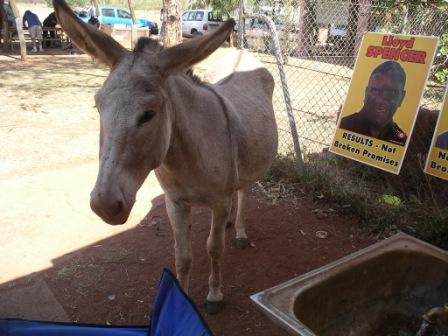
For the benefit of overseas visitors to this blog, Australia has a preferential voting system at all elections and it's compulsory.
You have to cast a vote for every candidate in order of preference by nunbering every square on your ballot paper.
Every political party hands out How to Vote cards with their preferred order of candidates.
It's supposed to be fairer than first past the post. But it means someone who doesn't get the most first preference votes can still squeeze through if they get enough preferences from other candidates.
Some ballot papers show the person voting cast their votes in numerical order from top to bottom. That's called a donkey vote.
But I never thought I'd see it so literally!
On the campaign trail
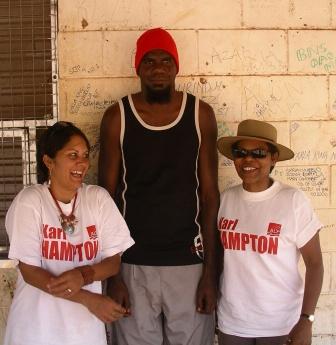
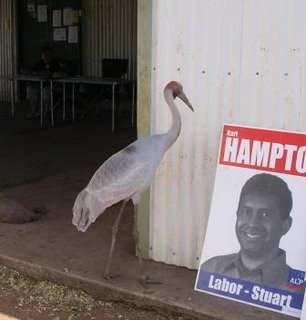
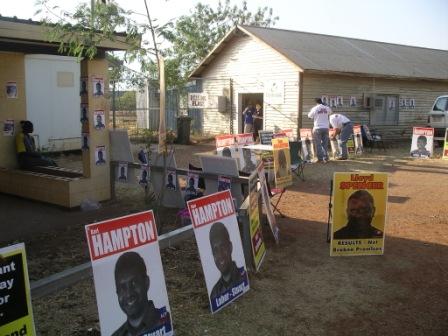
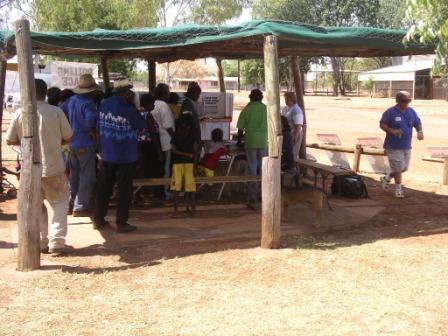
Last week I was out bush helping with mobile polling in the southern part of the Victoria River District.
As voting is compulsory in Australia, everyone has to be seen to be given the chance to vote.
So the Australian Electoral Commission sends out teams to collect votes in every remote community in the Territory.
And each political party sends out workers to hand out how to vote cards and soothe theircandidates
Where it's really remote, they come in by helicopter.
We went on a roadshow - 1900 km in three days.
Here's some pics of what it was like.
From top to bottom:
Two Labor MPs, Barbara McCarthy, Member for Arnhem (left) and Marion Scrymgour. Member for Arafura and Minister for Environment and Heritage, among other things, with a very tall punter who was keen to have his pic taken with them. Basketball (or in Kriol basgitbol) anyone?.
Brolgas can't vote. But that didn't deter this tame brolga (or Native Compantion, one of Australia's two true cranes) from hanging round the polling booth at Pigeon Hole.
The polling booth at Kalkaringi.
And at Daguragu, voting bush style.
Saturday, September 23, 2006
Rewriting history, and then some
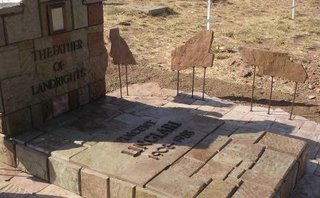
I've just come back from the twin communities of Daguragu and Kalkaringi, about 750km south-west of Darwin, the home of the Gurindji people, whose country extends an hour's drive to the east and a little further west.
More about why I was there in another post.
It's beautiful rolling savannah, emphasised by a few low hills and rocky ridges and outcrops.
One of these ridges - Wave Hill - gave its name to the cattle station whose stockmen were Gurindji.
And their struggle, which gave birth to the land rights movement in Australia, is what put it into the history books.
The station was selected in the late 1880s by old man Buchanan and up until the 1950s ran on largely unpaid Aboriginal labour.
From about the time of the First World War it was owned by the British Lord Vestey, a hugely wealthy absentee landlord.
Anthropologists Ronald and Catherine Berndt were hired by Vesteys in the late 1940s to investigate how Vestey's couild recruit more Aboriginal people into the industry.
That investigation turned into a damning report on industrial and living conditions on the Vestey stations that was shelved for more than 40 years.
It was finally published as 'End of an Era' in the early 90s.
The report, in sparse prose, related how Vesteys cruelly exploited Aboriginal workers, who were little more than slaves, working for rations - soup bones, offal, salt beef flour, sugar, tea and tobacco - and clothes.
Boys as young as 11 started in the industry and worked til they dropped.
Their health was poor and injuries went untreated.
While it is true the stations took care of dependants, they all had to do some work about the place for their short rations - children, the aged and the infirm
Many old men gimp around with broken hips, a common injury when you're on horseback around cattle.
From about the 1950s, there was a minimum wage and for many of the older men it was the first time they'd seen real money.
For others, who had worked for the Army during World War 2, it was back to the good old days.
In the 1960s the labour movement - mainly the wharfies and the North Australian Workers Union - began to agitate seriously for equal pay for Aboriginal stockmen.
The pastoralists argued vehemently against it, pointing out thaty Aboriginal stockmen weren't worth as much as whites.
And yet the industry had relied on their labour for more than half a century.
The Commonwealth Conciliation and Arbitration Commission eventually handed down its decision in 1966, proposing a gradual intriduction of equal wages over the following three years.
But the Wave Hill stockment had already had enough.
Led by Vincent Lingiari (that's his grave at the top of this post), they walked off Wave Hill station - men, women and children - and four days later camped at Wattie Creek.
It wasn't an arbitrary choice of camp.
Apart from having good water year-round, Wattie Creek is also Lawi - dreaming place for the Rainbow Serpent.
The significance of that escaped me until I visited the place last week, but it's now clear to me that a people who were believed to be fringe dwellers with no culture had all along nurtured it away from prying eyes.
Where else to go when you're turning your back on oppression?
The story of the strike is told in Frank Hardy's Unlucky Australians, a book that's as much about Frank as about the Gurindji.
Some of the srtikers went south and told of their conditions at union meetings.
Lupgna Giari, a Mudpura man, was questioned by journalists.
Surely stockmen got more than salt beef and flour? Oh yes, sometimes they bin put more salt on the beef.
But somewhere along the line, it emerged that striking for equal pay was only the tip of the iceberg, to use a geographically inappropriate metaphor.
What the Gurindji really wanted was their own land back.
The company and the government of the day tried everything to get them to go back to work.
Govenrment money eventually paid for housing at Kalkaringi, the site of the present-day community and then site then of the old Welfare rations depot.
But they sat it out.
Eventually Gough Whitlam came and poured the famous handful of sand into Vincent Lingiari's hand as he handed over the lease to the land.
They built another community at Daguragu, close to Lawi.
Early this month the Gurindji and their friends - among them Frank Hardy's son and granddaughter - joyfully celebrated the 40th anniversary of the walk-off.
There was a couple of sour notes, however.
One was the death of an old man from Daguragu.
And the other was the emergence of a revisionist history of the cattle days that asserted that the station owners were deeply saddened by the Wave Hill walk-off and all the other walk-offs that happened across Northern Australia.
They hadn't been in the interests of Aboriginal people and had forced the pastoralists into modernising their practices and employing fewer people.
That's a bit like blaming African Americans for getting equal rights and ending tghe colour bar.
But one of the the few surviving strikers had the last word.
Old and frail Hoppy Mick Rangiari - another one bearing the broken hip as a legacy of his days on the catttle - got up from his wheelchair and told the people at the celebrations; 'That Bestey been treat we like dogs'.
I'm with Hoppy Mick.
I trust the history that is in people's bones.
Friday, September 22, 2006
Reds under the bed
Many Aboriginal towns operate under some sort of local government scheme.
But it's for our convenience, not theirs.
To try and accommodate crazy whitefella ideas and get the funding they need to run the towns, build the houses and so on, they try to make the councils work in a way that allows for some expression of Aboriginal ways of doing things.
In some places, it's making sure that every clan is represented on the council.
That way the benefits are more likely to be shared equally - new houses, sewerage, council positions.
It doesn't quite work to the satisfaction of the beancounters, but it generally passes muster.
Except for our boofhead Federal Minister for Indigenous Affairs, that is.
Mal the Mouth was heard to rant at a conference of policemen recently that clan-based community councils were nothing more than 'communist collectives'.
I kid you not.
Mal pretends to be unaware that the only member of the Marx family to have any impact on Aboriginal people was Groucho.
And he should know that the most widely-read book in Aboriginal domains is the Bible.
Emphatically not Das Kapital.
So why the rant?
One of my earlier blogs mentioned dogwhistle politics and this is a classic example: the subtext says these communist collectives are un-Australian, so the normal rules don't apply.
The Government is within its rights to subject them to scrutiny and cut off their funding if there's a sniff of suspect practices.
Which of course the government will find.
It's always easier in politics to demonise people.
It worked for George Bush.
But I don't think even he would return to the Cold War era to find a justification for reactionary and repressive policies.
But it's for our convenience, not theirs.
To try and accommodate crazy whitefella ideas and get the funding they need to run the towns, build the houses and so on, they try to make the councils work in a way that allows for some expression of Aboriginal ways of doing things.
In some places, it's making sure that every clan is represented on the council.
That way the benefits are more likely to be shared equally - new houses, sewerage, council positions.
It doesn't quite work to the satisfaction of the beancounters, but it generally passes muster.
Except for our boofhead Federal Minister for Indigenous Affairs, that is.
Mal the Mouth was heard to rant at a conference of policemen recently that clan-based community councils were nothing more than 'communist collectives'.
I kid you not.
Mal pretends to be unaware that the only member of the Marx family to have any impact on Aboriginal people was Groucho.
And he should know that the most widely-read book in Aboriginal domains is the Bible.
Emphatically not Das Kapital.
So why the rant?
One of my earlier blogs mentioned dogwhistle politics and this is a classic example: the subtext says these communist collectives are un-Australian, so the normal rules don't apply.
The Government is within its rights to subject them to scrutiny and cut off their funding if there's a sniff of suspect practices.
Which of course the government will find.
It's always easier in politics to demonise people.
It worked for George Bush.
But I don't think even he would return to the Cold War era to find a justification for reactionary and repressive policies.
I'd thought reds under the bed existed only in the febrile imagination of ratbag conservatives in the 60s.
It seems I was wrong.
John Howard and his gang strike again with Back to the Future.
That's the true measure of the intellectual and moral bankruptcy of this government.
Sunday, September 10, 2006
Maningrida (or Manayingkarrira)
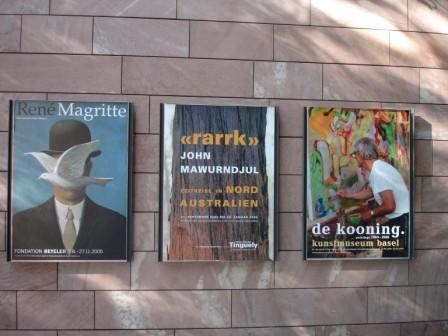
Two giants of European contemporary art flank an emerging giant of the art world in posters on a wall in Basel, Switzerland. John Mawurndjul is from Maningrida, a community of 2000-odd at the mouth of a river in Central Arnhem Land. Mawurndjul was on the cover of Time magazine earlier this year and is one of a half-dozen Aboriginal artists from various parts of Australia who have contributed work to the interior design of the Musee de Quai Branly in Paris. He painted a supporting column and part of the ceiling.
The 'rarrk' in the poster refers to the cross-hatching and other devices in bark and body paintings that bury the real meaning of the story that's been painted. An Aboriginal painting in these domains is not simply a work of art; it's also a statement of identity, inheritance and right - right of ownership of land or to a ceremonial story that confers responsibilities for land, resources or family. That true story is closed to people who are not entitled to know it, but they may be told an abridged and simplified version - the 'outside' story - while the real one - the 'inside' story' - remains safe and secure in plain sight.
I'm flying out there tomorrow on a work visit, looking at how the community is managing on the Community Development Employment Project. It's a program through which people voluntarily work for their legal entitlement to unemployment benefits. The program is under attack from the Federal Government, which wants Aboriginal people everywhere to have 'access to the free market' and embrace capitalism. Both of these are difficult concepts for people like Mawurndjul, whose apparently considerable income from painting supports an extended family.
More on this later, when I get back.
Tuesday, September 05, 2006
Violence
Last week I was interviewed on ABC Radio's morning program as Vice President of the Northern Territory Council of Government School Organisations.
Dopy Dave had jumped on unrest about juvenile crime and organised a 'community forum' with the sole intention of gaining a bit of political capital.
He'd invited the Federal Minister for Justice along and this Minister made the astounding suggestion that we go back to hitting kids at school to help solve the problem.
I couldn't believe it and I said so: was he seriously advocating common assault as an element of our educational philosophy?
The interviewer, playing devil's advocate, asked me if I'd been subjected to corporal punishment at school, and whether it made me behave.
I went to a boarding school on England which, pace the late David Sandison, I will call St Onan's.
I was caned on the backside and on the hand with wooden and bamboo canes, beaten with gym slippers (what we used to call 'Trainers', dear) and was the target of blackboard dusters or viciously thrown pieces of chalk.
Old Thos, the woodwork teacher, would hurl a lump of wood at innocently daydreaming kids and accompany the 'thunk' of it hitting your head with the declamation: 'behold thy fairy godmother', delivered in a South Yorkshire accent.
I was also imprisoned (school detentions on weekends), I was bullied (made to do repetitive and degrading drills) stood over and sexually assaulted. And that was just by teachers.
The conservative response is to say '...and it never did me any harm'.
Bullshit.
Violence begets violence and assaults of this nature are psychologically damaging even if all they engender is a deep-rooted belief that violence is an acceptable solution.
I didn't behave. I was humiliated and resentful of my personal space being invaded so intimately and with such ease.
People who don't think things through particularly well always come back to a violence-based discipline approach (behavior management, they call it these days) as THE answer.
They also tend to blame schools for kids running riot, when it is essentially a social problem.
And if society can't or won't deal with it, there's little point demanding that schools accept the entire responsibility and empowering them to assault into the bargain.
I'm raising this here because I've been thinking about the way Aboriginal people are mystified by our culture's ability to perpetrate an atrocity like the Stolen Generations, a psychic as well as physical wound which reverberates down through succeeding generations.
'How could you do it to children?' they ask.
'After all the stuff you talk about families, how could you take children away from their mothers?'
The asking, I think, carries an implicit assumption that there may be something, some answer, that will explain everything.
There is no logic to it.
But you can gain some insights into how it happened by looking at the way many among us are prepared to treat children from our own culture - particularly the children of the marginalised, who are themselves marginalised educationally and who are likely to carry on what have become family traditions of being economically marginalised.
I was a smart working class boy and my teachers were generally of a middle class educated elite.
Much of what I went through may well be described dispassionately as rites of passage.
But they did it because they could get away with it - and they did.
And, clearly, there are still people in power who think it's OK to advocate violence against children as a panacea for social ills.
Dopy Dave had jumped on unrest about juvenile crime and organised a 'community forum' with the sole intention of gaining a bit of political capital.
He'd invited the Federal Minister for Justice along and this Minister made the astounding suggestion that we go back to hitting kids at school to help solve the problem.
I couldn't believe it and I said so: was he seriously advocating common assault as an element of our educational philosophy?
The interviewer, playing devil's advocate, asked me if I'd been subjected to corporal punishment at school, and whether it made me behave.
I went to a boarding school on England which, pace the late David Sandison, I will call St Onan's.
I was caned on the backside and on the hand with wooden and bamboo canes, beaten with gym slippers (what we used to call 'Trainers', dear) and was the target of blackboard dusters or viciously thrown pieces of chalk.
Old Thos, the woodwork teacher, would hurl a lump of wood at innocently daydreaming kids and accompany the 'thunk' of it hitting your head with the declamation: 'behold thy fairy godmother', delivered in a South Yorkshire accent.
I was also imprisoned (school detentions on weekends), I was bullied (made to do repetitive and degrading drills) stood over and sexually assaulted. And that was just by teachers.
The conservative response is to say '...and it never did me any harm'.
Bullshit.
Violence begets violence and assaults of this nature are psychologically damaging even if all they engender is a deep-rooted belief that violence is an acceptable solution.
I didn't behave. I was humiliated and resentful of my personal space being invaded so intimately and with such ease.
People who don't think things through particularly well always come back to a violence-based discipline approach (behavior management, they call it these days) as THE answer.
They also tend to blame schools for kids running riot, when it is essentially a social problem.
And if society can't or won't deal with it, there's little point demanding that schools accept the entire responsibility and empowering them to assault into the bargain.
I'm raising this here because I've been thinking about the way Aboriginal people are mystified by our culture's ability to perpetrate an atrocity like the Stolen Generations, a psychic as well as physical wound which reverberates down through succeeding generations.
'How could you do it to children?' they ask.
'After all the stuff you talk about families, how could you take children away from their mothers?'
The asking, I think, carries an implicit assumption that there may be something, some answer, that will explain everything.
There is no logic to it.
But you can gain some insights into how it happened by looking at the way many among us are prepared to treat children from our own culture - particularly the children of the marginalised, who are themselves marginalised educationally and who are likely to carry on what have become family traditions of being economically marginalised.
I was a smart working class boy and my teachers were generally of a middle class educated elite.
Much of what I went through may well be described dispassionately as rites of passage.
But they did it because they could get away with it - and they did.
And, clearly, there are still people in power who think it's OK to advocate violence against children as a panacea for social ills.
Monday, September 04, 2006
Wednesday, August 30, 2006
More on Mr Limbunya
The TV news last night carried an extensive report on the tragic death of a Darwin boy who has been in a coma since he was hit by a falling limb in a schoolyard last week.
It didn't mention Mr Limbunya's death at all.
Enough said.
There are people who won't let it rest there.
Nawala's grandson, for one.
Matthew Bonson is a member of the Territory Assembly (our peanut Parliament).
He's written to the Health Minister asking for a full inquiry into what happened to his old uncle and the Health Minister says that's just what they'll do.
Matthew must know in his heart of hearts that they'll miss the point, though.
The real inquiry needs to be into how racism survives in Australia and how we can get rid of it.
It didn't mention Mr Limbunya's death at all.
Enough said.
There are people who won't let it rest there.
Nawala's grandson, for one.
Matthew Bonson is a member of the Territory Assembly (our peanut Parliament).
He's written to the Health Minister asking for a full inquiry into what happened to his old uncle and the Health Minister says that's just what they'll do.
Matthew must know in his heart of hearts that they'll miss the point, though.
The real inquiry needs to be into how racism survives in Australia and how we can get rid of it.
Tuesday, August 29, 2006
Shame job
This is a shameful story.
It happened over a few days, starting with people gathering for celebrations of the 40th anniversary of the walk-off from Wave Hill - a landmark in the struggle for land rights.
People from all over Australia gathered at the communities of Daguragu and Kalkaringi for the event.
Ironic really, because our Federal Government has just gutted the Land Rights Act which owes much of its conception to the inspiration of Vincent Lingiari and the men and women who walked off Lord Vestey's Wave Hill Station.
Among the people who came for the celebrations was a blind and infirm elderly man, now known to be Mr Limbunya, who was dropped off at the Kalkaringi airstrip (about 750km south-west of Darwin) by a medical plane from Katherine.
When I say 'dropped off', I mean just that.
The plane left him at the airstrip.
It was 5km from Kalkaringi.
No-one was there to meet him because no-one knew he was coming back, although he was one of the few old people left from the time of the walk-off.
The plane took off and left him standing there.
What happened then is anyone's guess, but he probably tried to walk - he wasn't wearing any shoes - from the airstrip to either Daguragu, the neighbouring community he preferred, or maybe even to Limbunya, the place where he was born and whose name he bore.
No-one knew he was gone for three days.
Then the alarm was raised.
The search was called off on the weekend, but yesterday they found his body - nine days after he 'disappeared'.
Mr Limbunya's sister, Nawala, was one of the Stolen Generation.
Although they shared the same mother, his father was a proper way Gurindji man and Nawala's was the Irish station overseer.
She was taken to the Kahlin 'half-caste' children's home in Darwin before she turned 10 - a hard ride on horseback with the local policemen and then a lugger ride down the Victoria River and on across Joseph Bonaparte Gulf to Darwin - and didn't get back to see him until she was well into her 60s.
He couldn't see her, because he was already blind, but he knew her all right.
Nawala died in her 80s surrounded by family and she was mourned by both black and white people in Darwin.
There were upwards of 1500 people at her funeral service, many of them travelling to the graveside in an apparently endless stream of cars that were shepherded by police to the cemetery.
The Mill Sisters sang 'Arafura Pearl' to farewell her and, as the earth covered her coffin, a V-formation flight of pelicans wheeled over the paperbarks and flew away.
Mr Limbunya, on the other hand, died alone.
He'll have a big send-off, to be sure.
But he died away from family, and maybe his country too.
And what happened to him typfies for me what many of our fellow Australians think of the First Australians and it typifies how the current Government is dealing with them.
They're inconvenient, they're not worth treating with common decency and - ultimately - they're disposable.
There'll be an inquiry to find out how it happened.
But it's too late.
You just know it would never happen to a white man.
And you know why.
This is Australia in the year 2006.
God help us.
It happened over a few days, starting with people gathering for celebrations of the 40th anniversary of the walk-off from Wave Hill - a landmark in the struggle for land rights.
People from all over Australia gathered at the communities of Daguragu and Kalkaringi for the event.
Ironic really, because our Federal Government has just gutted the Land Rights Act which owes much of its conception to the inspiration of Vincent Lingiari and the men and women who walked off Lord Vestey's Wave Hill Station.
Among the people who came for the celebrations was a blind and infirm elderly man, now known to be Mr Limbunya, who was dropped off at the Kalkaringi airstrip (about 750km south-west of Darwin) by a medical plane from Katherine.
When I say 'dropped off', I mean just that.
The plane left him at the airstrip.
It was 5km from Kalkaringi.
No-one was there to meet him because no-one knew he was coming back, although he was one of the few old people left from the time of the walk-off.
The plane took off and left him standing there.
What happened then is anyone's guess, but he probably tried to walk - he wasn't wearing any shoes - from the airstrip to either Daguragu, the neighbouring community he preferred, or maybe even to Limbunya, the place where he was born and whose name he bore.
No-one knew he was gone for three days.
Then the alarm was raised.
The search was called off on the weekend, but yesterday they found his body - nine days after he 'disappeared'.
Mr Limbunya's sister, Nawala, was one of the Stolen Generation.
Although they shared the same mother, his father was a proper way Gurindji man and Nawala's was the Irish station overseer.
She was taken to the Kahlin 'half-caste' children's home in Darwin before she turned 10 - a hard ride on horseback with the local policemen and then a lugger ride down the Victoria River and on across Joseph Bonaparte Gulf to Darwin - and didn't get back to see him until she was well into her 60s.
He couldn't see her, because he was already blind, but he knew her all right.
Nawala died in her 80s surrounded by family and she was mourned by both black and white people in Darwin.
There were upwards of 1500 people at her funeral service, many of them travelling to the graveside in an apparently endless stream of cars that were shepherded by police to the cemetery.
The Mill Sisters sang 'Arafura Pearl' to farewell her and, as the earth covered her coffin, a V-formation flight of pelicans wheeled over the paperbarks and flew away.
Mr Limbunya, on the other hand, died alone.
He'll have a big send-off, to be sure.
But he died away from family, and maybe his country too.
And what happened to him typfies for me what many of our fellow Australians think of the First Australians and it typifies how the current Government is dealing with them.
They're inconvenient, they're not worth treating with common decency and - ultimately - they're disposable.
There'll be an inquiry to find out how it happened.
But it's too late.
You just know it would never happen to a white man.
And you know why.
This is Australia in the year 2006.
God help us.
Thursday, August 24, 2006
But wait! There's more!
Try this for size:
'The EsseNTial Learnings are developmentally mapped to achieve culminating outcomes. These outcomes are developed through the content of relevant Learning Areas and can be used as a strategy for curriculum integration. By their nature, the EsseNTial learnings are both part of the NTCF outcome structure and an enabler of inclusive needs-based program development. Schools need to create environments, programs and structures that present opportunities for learners to participate in a meangful way to ensure that these EsseNTial learnings are acquired.'
This appears in the Northern Territory's Curruculum Framework. What does it mean?
But don't you just lerve '...creating opportunities for ...meaningful participation...'? In other words, if you don't grab the 'opportunity', it's your fault!
'The EsseNTial Learnings are developmentally mapped to achieve culminating outcomes. These outcomes are developed through the content of relevant Learning Areas and can be used as a strategy for curriculum integration. By their nature, the EsseNTial learnings are both part of the NTCF outcome structure and an enabler of inclusive needs-based program development. Schools need to create environments, programs and structures that present opportunities for learners to participate in a meangful way to ensure that these EsseNTial learnings are acquired.'
This appears in the Northern Territory's Curruculum Framework. What does it mean?
But don't you just lerve '...creating opportunities for ...meaningful participation...'? In other words, if you don't grab the 'opportunity', it's your fault!
Say what you mean
'Then you should say what you mean,' the March Hare went on. 'I do,' Alice hastily replied; 'at least - at least I mean what I say - that's the same thing, you know.' 'Not the same thing a bit! said the Hatter. 'Why, you might just as well say that "I see what I eat" is the same thing as "I eat what I see!"'
Lewis Carrol - Alice's Adventures in Wonderland
I had a strange encounter with a voice recognition system a couple of weeks ago when I was in Canberra. The taxi company has changed over to a VR system for booking calls. It had no difficulties with the pick-up point at all. But it was another story when it came to my destination.
- I'd like to go to the Australian National University.
- You want to go to Murrumbateman. Is that correct?
- No. I want to go to the Australian National University.
- You want to go to Captain's Flat. Is that correct?
- No (getting irate and speaking through gritted teeth now). I don't want to go to Captain's Flat or fucking Murrumbateman. I want to go to the Australian National University.
- I don't understand. Please state your destination.
- Can I speak to a human being?
- I don't understand. Please state your destination.
It occurred to me that trying to talk (and listen to) bureaucrats and politicians offers a similar Alice in Wonderland experience. They seem to speak and (god forbid!) think in a language that appears to be English; but not only is it difficult to get a straight answer to a straight question, you also have difficulty interpreting precisely what particular words or groups of words mean.
You know the sort of thing: words like resources, issues, prioritising, deliverables, performance indicators and so on, which are strung together like fat beans on a string. They're used by an in-group among themselves and we assume that they all understand precisely what they're talking about - although the words in question are always ill-defined to the point of being ephemeral. So maybe they don't.
But then they go out into the real world and start talking in the same terms to people who speak and think in plain old English. And because we don't like to be thought of as stupid, or because we're too damn polite for our own good, we rarely stop them to ask what they mean by a particular turn of phrase. And then we start using them, too!
Why? Partly, I think, because we want to be seen to be part of a power elite and so we use the language of power whether we really understand it or not. And maybe partly because we're too tired to resist any more.
But you can't reach those dizzy heights without mastering the use of the passive voice - the ultimate in power tripping. People don't get together to do things. They're '...invited to participate...'.
As you can see, the term puts one group (the elite) in the position not just of 'inviting', but defining what it is that the other group (those without power) will 'participate' in. Whatever the result (the current fave is 'outcome'), it will be described as '..a meaningful (now there's a much misused word!) exercise in community involvement...'.
It's nothing of the sort, of course. It's one group of people getting another group to do something they've already defined and whose 'outcomes' they have already predicted.
If you're serious about people defining their destiny, then you don't 'invite them to participate' in anything. You ask them what they want to do and then make damn sure nothing stands in the way of them doing it. As long as it's a reasonable and negiotable ask, that is.
This misuse of the language is doubly damnable when bureaucrats try to use the language among people who don't have English as a first language. Not just Indigenous people, either; people from other countries who now live here. It's very easy to use the words to soothe people into believing someone cares about what they say, they're really listening and something is happening that they'll like - or at least something that will be good for them.
And then reality bites. Fine-sounding policy is revealed for what it is - generally a cynical exercise in avoiding responsibility - and the real people become at best exhausted and at worst embittered by the experience.
As a taxpayer, I don't think it's too much to ask of governments who say they want to serve the public good to make sure (ensure) its diverse servants (our servants) at least learn how to speak and - more importantly - how to listen - without turning everything into their own polysyllabic porridge.
To return to Alice ('Remember Alice? There's a song about Alice. Which shows my age, I think), say what you mean!
Lewis Carrol - Alice's Adventures in Wonderland
I had a strange encounter with a voice recognition system a couple of weeks ago when I was in Canberra. The taxi company has changed over to a VR system for booking calls. It had no difficulties with the pick-up point at all. But it was another story when it came to my destination.
- I'd like to go to the Australian National University.
- You want to go to Murrumbateman. Is that correct?
- No. I want to go to the Australian National University.
- You want to go to Captain's Flat. Is that correct?
- No (getting irate and speaking through gritted teeth now). I don't want to go to Captain's Flat or fucking Murrumbateman. I want to go to the Australian National University.
- I don't understand. Please state your destination.
- Can I speak to a human being?
- I don't understand. Please state your destination.
It occurred to me that trying to talk (and listen to) bureaucrats and politicians offers a similar Alice in Wonderland experience. They seem to speak and (god forbid!) think in a language that appears to be English; but not only is it difficult to get a straight answer to a straight question, you also have difficulty interpreting precisely what particular words or groups of words mean.
You know the sort of thing: words like resources, issues, prioritising, deliverables, performance indicators and so on, which are strung together like fat beans on a string. They're used by an in-group among themselves and we assume that they all understand precisely what they're talking about - although the words in question are always ill-defined to the point of being ephemeral. So maybe they don't.
But then they go out into the real world and start talking in the same terms to people who speak and think in plain old English. And because we don't like to be thought of as stupid, or because we're too damn polite for our own good, we rarely stop them to ask what they mean by a particular turn of phrase. And then we start using them, too!
Why? Partly, I think, because we want to be seen to be part of a power elite and so we use the language of power whether we really understand it or not. And maybe partly because we're too tired to resist any more.
But you can't reach those dizzy heights without mastering the use of the passive voice - the ultimate in power tripping. People don't get together to do things. They're '...invited to participate...'.
As you can see, the term puts one group (the elite) in the position not just of 'inviting', but defining what it is that the other group (those without power) will 'participate' in. Whatever the result (the current fave is 'outcome'), it will be described as '..a meaningful (now there's a much misused word!) exercise in community involvement...'.
It's nothing of the sort, of course. It's one group of people getting another group to do something they've already defined and whose 'outcomes' they have already predicted.
If you're serious about people defining their destiny, then you don't 'invite them to participate' in anything. You ask them what they want to do and then make damn sure nothing stands in the way of them doing it. As long as it's a reasonable and negiotable ask, that is.
This misuse of the language is doubly damnable when bureaucrats try to use the language among people who don't have English as a first language. Not just Indigenous people, either; people from other countries who now live here. It's very easy to use the words to soothe people into believing someone cares about what they say, they're really listening and something is happening that they'll like - or at least something that will be good for them.
And then reality bites. Fine-sounding policy is revealed for what it is - generally a cynical exercise in avoiding responsibility - and the real people become at best exhausted and at worst embittered by the experience.
As a taxpayer, I don't think it's too much to ask of governments who say they want to serve the public good to make sure (ensure) its diverse servants (our servants) at least learn how to speak and - more importantly - how to listen - without turning everything into their own polysyllabic porridge.
To return to Alice ('Remember Alice? There's a song about Alice. Which shows my age, I think), say what you mean!
Subscribe to:
Posts (Atom)